Peters
The Spy Who Came in from the ColdPeters is the controlled, observant interrogator who receives Alec Leamas after his apparent defection and questions him about his intelligence work. He is both a practical organiser of Leamas’s passage east and an exacting evaluator of his disclosures: his professional composure makes the interrogation feel less like a simple exchange of secrets than a contest over what can be made to count as evidence.
Identity and Introduction
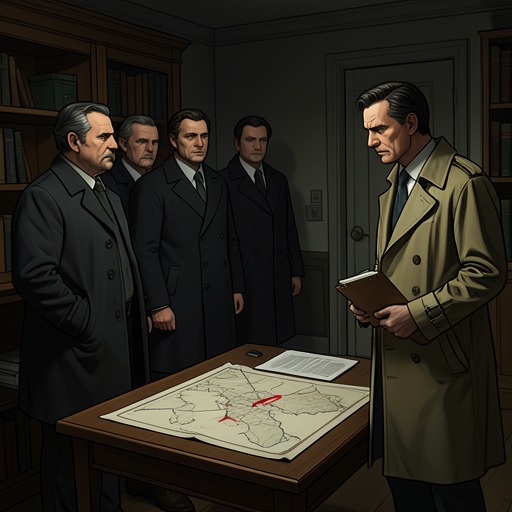
Peters first appears at Sam Kiever’s house, where he arrives in a leather-buttoned macintosh. Leamas estimates him to be about fifty-five, roughly his own height, with a hard grey face deeply furrowed and a bearing that might suggest a soldier. Peters introduces himself, offers his hand, and asks whether Leamas had a good journey. His polished fingers and restrained manner establish a courteous surface that gives little away.
At the table, Peters asks whether Kiever has told Leamas the payment: fifteen thousand pounds, to be drawn on a Bern bank. The sum makes the exchange concrete, but Peters does not begin by bargaining over it. He picks up a pencil and asks about Leamas’s war service, initiating a methodical examination of the history and credibility of the man in front of him.
Interrogation and Method
Peters later turns to Leamas’s Berlin service, specifying the period from May 1951 to March 1961 and offering him another drink. The precision of the dates frames the interview as an organised account to be tested, not an informal conversation. Leamas notices that Peters is left-handed and that he puts his cigarette in his mouth with the maker’s name turned away, so it burns first. The small gesture suggests to Leamas that Peters, like himself, has been on the run.
The narrative describes the interrogation as a struggle between the professional’s trained selectivity and the examiner’s need to recover what that selectivity conceals. Leamas may omit facts out of pride, defiance, or professional habit; worse for the interrogators, he may anticipate what they want and choose his disclosures accordingly, leaving out an apparently incidental detail that could matter to the evaluators. Peters is aware of this difficulty. He must identify falsehoods while confronting a source whose expertise can itself distort the information he supplies.
Peters is also portrayed as a recovered alcoholic whose vanity can be capricious. Yet Leamas sees in him an orthodoxy grounded in strength and confidence, and distinguishes his possible lies from the fumbling dishonesty he associates with William Ashe. In Leamas’s estimation, a lie from Peters would be calculated and necessary. That judgment does not make Peters transparent; it gives his reserve a professional logic that Leamas recognises, even while resisting a human bond with his interrogator.
Riemeck and the Question of a Collaborator
During the account of Karl Riemeck, Peters interrupts to ask whether all the intelligence came from Riemeck. Leamas answers that Riemeck had access to a great deal, but Peters finds the claim scarcely possible and concludes that Riemeck must have had help. The exchange marks a turning point in the questioning: Peters is not satisfied with a catalogue of information and instead tests what the information implies about its source and reach.
The material Leamas describes includes the minutes of the Praesidium’s latest meeting, a draft revision concerning East Germany’s relationship to COMECON, and a breakdown of the East German Intelligence Service, including departmental functions and personal details. Peters’s doubt about Riemeck’s ability to obtain this material alone becomes more significant when Leamas remembers that Control had asked the same question about Riemeck’s access. The two men’s agreement suggests that both suspect a high-level collaborator, potentially the Special Interest whom Control is determined to protect from Hans-Dieter Mundt.
As Leamas considers that possibility, he realises that Riemeck may have worked with someone whose position enabled the pair to gather what Riemeck could not have obtained by himself. The recollection also prompts him to wonder whether Control had spoken privately with Riemeck about that person. Peters does not supply the answer, but his insistence helps make the missing collaborator an organising question in Leamas’s understanding of the operation.
From Examination to East Germany
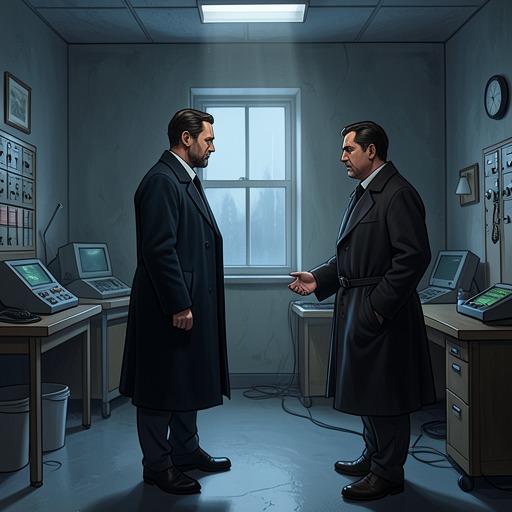
Later, when Peters arrives at three o’clock, he does not sit at the table or remove his macintosh. He tells Leamas that there is bad news: the authorities are looking for him in England and watching the ports. The changed posture and abrupt announcement signal that their arrangement has entered a new phase, in which the immediate problem is no longer only what Leamas has told Peters but how to get him out of the country.
When Leamas agrees to proceed, Peters says there is no flight east until the following day, but that they can take a flight to Berlin in an hour. The urgency is answered by careful preparation. Leamas travels on a passport made out to Alexander Thwaite, a travel agent, filled with the visas and frontier stamps of a well-used professional traveller. At the Dutch airport frontier, the guard gives it only a cursory stamp; Peters waits several places behind and takes no interest in the formalities. His arrangements present movement across borders as routine even as the false identity and short timetable reveal how much of the journey has been prepared in advance.
The crossing into East Germany is similarly coordinated. The Mercedes waits behind a DKW; the smaller car goes ahead to the West German checkpoint, and after the barrier rises, both vehicles cross together. The arrangement carries Leamas through the fifty yards between the checkpoints, past new fortifications, observation towers, dragons’ teeth, and double aprons of barbed wire. The pair do not stop in East Berlin as Leamas expects; they continue east. Peters’s role in the journey is thus practical as well as interrogative: he helps carry the apparent defector from a controlled questioning environment into the territory where the larger design will be tested.
What Peters’s Questions Expose
Peters’s scepticism about Riemeck’s sources foreshadows the conflict between Fiedler and Mundt. When Fiedler insists that Leamas’s story is unfinished and asks what he would conclude if given the same indications of a spy inside a department, the problem resembles the one Peters had already raised: scattered facts may suggest a source at a particular level without proving who that person is. Peters’s questions help establish that intelligence is not self-interpreting; access, gaps, and the pattern of disclosures matter as much as the information itself.
Evidence later presented by Fiedler gives the suspicion a sharper shape. A Copenhagen bank reports that the co-signatory to Leamas’s account withdrew the deposited money a week after it was paid in, on a date coinciding with Mundt’s visit to Denmark under an alias. In the Tribunal, Fiedler recapitulates the account: Leamas deposited ten thousand dollars at Copenhagen on June 15, and the co-signatory drew the sum a week later; a second deposit in Helsinki is matched to Mundt’s clandestine journey to Finland on October 3. Fiedler also revisits the special security rules governing the circulation of Operation Rolling Stone and the letters to the Copenhagen and Helsinki banks. These details show why an interrogator might treat apparently minor administrative traces as clues to a concealed relationship.
At the Tribunal, Leamas insists that, as head of the Berlin Command, he would have known if Mundt had been working for the British, because it would have been administratively impossible to run him against East Germany without the Berlin station’s knowledge. Fiedler counters that Leamas himself has provided the answer, linking the case to the bank evidence. When the Tribunal’s presiding voice states that Leamas is already under arrest and that the body has no executive powers, Leamas suddenly understands the trick. Peters is not identified as the author of that final revelation, but the earlier interrogation has prepared its central logic: testimony, operational procedure, and financial traces can be assembled into a persuasive pattern, while the person supplying the evidence may not understand the design in which it is being used.
Peters’s significance lies in that double function. He appears as a calm examiner who knows that a professional source can mislead through selective truth, and as an efficient organiser whose arrangements bring Leamas within reach of the East German investigation. His probing question about Riemeck’s unseen help does not resolve the mystery; it gives the mystery its durable form, directing attention from what an agent knows to how he could have known it, and to the hidden person whose position might explain the difference.